I've been doing this long enough to know that whitepapers lie. Not intentionally most founders genuinely believe their own pitch decks but the gap between "theoretical maximum throughput" and "what actually happens when you have a billion dollars at stake" is where projects live or die.
By 2026, we've seen enough cycles to recognize the patterns. The 2021 era mistakes of confusing high APYs with product market fit, or conflating TVL with actual usage, feel almost quaint now. Today's sophisticated investors and honestly, anyone who wants to keep their capital need a different lens.
So here's how I actually look at a new project when it crosses my desk. Not a checklist. Not a rubric. Just the mental model I've developed over years of watching things break in interesting ways.
This assessment framework is organized into four phases, each building on the last. Together they trace the full stack from base layer consensus to end user economics, with cross cutting lenses for lifecycle maturity and institutional compliance:
- Phase 1 L1 Assessment: Consensus, decentralization, execution engines, censorship resistance, and tokenomics at the foundation layer.
- Phase 2 L2 Assessment: Rollups, parachains, subnets how scaling works, sequencer trust, data availability, and exit mechanisms.
- Phase 3 Infrastructure: Oracles, indexers, RPCs, bridges, and storage the hidden dependencies that make or break a "decentralized" system.
- Phase 4 DApp Assessment: Tokenomics, retention, security audits, regulatory posture, and whether the application creates sustainable value.
From User Click to Finality: The Hidden Journey
Before diving into technical details, visualize a single user action flowing through the entire stack. Every box represents a component controlled by someone. Every arrow represents trust. Every represents a potential failure point.
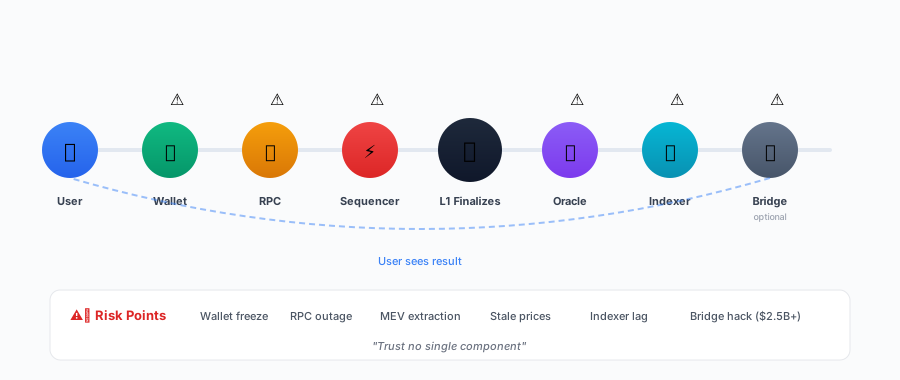
At every single step, something can go wrong. The wallet can freeze. The RPC can censor (remember the Infura outages). The sequencer can front run or censor liquidations. The oracle can report stale prices. The indexer can lag, showing users fake data. The bridge can collapse (over $3B stolen since 2021). Each component we assess exists to make this flow reliable or introduces risk that makes it fragile.
Table of Contents Part 1: Foundations
Phase 1 Starting at the Foundation (L1 Assessment)
When someone pitches me their "revolutionary new chain," I always start with the same question: What did you choose to optimize for, and what did you sacrifice?
Because here's the thing about base layers in 2026 there are no free lunches anymore. The Ethereum folks chose decentralization and settlement guarantees, accepting that they'll never beat Solana on raw throughput. The Solana team chose performance, knowing they'd take heat for hardware requirements that centralize validation. Both made valid choices. Both have very different risk profiles.
Throughout this section, I'll use seven major L1s as concrete examples to illustrate these tradeoffs: Ethereum (the decentralization gold standard), Solana (high performance monolithic), Polkadot (heterogeneous sharding with shared security), Cardano (formal verification focus), Avalanche (subnets for enterprise), Sui (MoveVM with object centric design), and Cosmos (sovereign appchains with IBC interoperability). These aren't the only chains worth studying, but they represent distinct architectural choices that illuminate the decision space every new L1 enters.
L1 Comparison Matrix: The Hard Data
| Dimension | Ethereum | Solana | Polkadot | Cardano | Avalanche | Sui | Cosmos |
|---|---|---|---|---|---|---|---|
| Consensus | PoS (Gasper) | PoH + PoS | Nominated PoS (GRANDPA/BABE) | Ouroboros PoS | Avalanche Consensus | Mysticeti BFT | CometBFT (per chain) |
| Block Time | ~12 seconds | ~400ms | ~6 seconds | ~20 seconds | ~1 second | ~400ms | ~1-6 seconds (chain dependent) |
| Finality | ~13 min (finalized) | ~12 seconds | ~12-60 seconds | ~5-10 minutes (practical finality via Ouroboros) | ~1-2 seconds | ~300ms (final) | ~1-6 seconds (instant finality) |
| Execution VM | EVM | SVM (Solana VM) | WASM (ink!, EVM via Moonbeam) | EVM (K), Plutus (native) | EVM + Custom | MoveVM | EVM, CosmWasm (choose per chain) |
| Throughput (TPS) | ~15-30 TPS | ~400-65K TPS | ~1,000 TPS (parachains aggregate higher) | ~250 TPS | ~4,500 TPS/subnet | ~100K+ TPS (horizontal scaling) | ~1,000-10K TPS (per chain) |
| Validator Count | ~1M+ validators (~5K-7K unique nodes) | ~1,500-1,700 | ~300 (nominated) | ~3,000 | ~1,500 | ~100-150 | ~150-175 (per chain, varies) |
| Node Operators | ~5K-7K unique operators running 1M validators | ~1,500 validators | 300 validators | ~3,000 validators | ~1,500 validators | ~100-150 validators | 100-175 per chain |
| Client Diversity | 4 major clients (Geth, Nethermind, Besu, Erigon) | 1 dominant client (90%+) | 2-3 clients | Multiple clients | 2-3 clients | 1 dominant client | CometBFT standard |
| Top Entities Control | Lido protocol ~30% (decentralized, 30+ independent operators), Coinbase ~15%. Top 3 pools ~45% but no single operator >33%. | Top 3 validators ~25-30% (single entities) | Top 3 validators ~20-25% | Top 3 pools ~15-20% | Top 3 validators ~20-25% | Foundation + top 3 validators ~40-50% | Varies: top 3 ~15-35% |
| Stake Distribution | Good: No entity >33%, liquid delegation allows reallocation | Moderate: Delegation flows to established pools | Good: NPoS promotes spread with rotation | Excellent: Thousands of pools, no dominant entity | Moderate: Minimum stake limits participation | Limited: Foundation holds significant portion | Varies: Good on established chains |
| Geographic Distribution | Excellent: 60+ countries | Good: 30+ countries | Good: 40+ countries | Excellent: 70+ countries | Moderate: US/EU concentration | Moderate: Growing | Good: Varies by chain |
| Validator Costs | Code: 32 ETH (~$100K). Active: 1M+ validators (no cap). OpEx: $1K-3K HW, $50-200/mo cloud. Barrier: Capital. | Code: $0 min. Active: 1,500 slots (vote-based). OpEx: $6K-15K HW, $3K-8K/mo cloud, ~$100/day vote fees. Barrier: Technical + OpEx. | Code: $0 min. Active: 297 slots. Effective: 1.5M-3M+ DOT (~$15M-30M delegated). OpEx: $3K-8K HW. Barrier: Social/Delegation. | Code: $0 min. Active: 3,000+ pools. Effective: 100K-500K+ ADA (~$100K-500K delegated). OpEx: $500-2K HW. Barrier: Social/Delegation. | Code: 2,000 AVAX (~$80K). Active: 50-100 per subnet. OpEx: $3K-8K HW, $500-2K/mo cloud. Barrier: Capital. | Code: $50K-500K+ stake. Active: 20-100 slots (permissioned/foundation selected). OpEx: $10K-25K HW. Barrier: Social/Permission. | Code: 1K-250K+ tokens. Active: 100-150 typical. Effective: Varies (1M-50M+ tokens delegated). OpEx: $1K-10K HW. Barrier: Social/Delegation. |
| Concentration Risk | Low: Top 3 ~45% (Lido ~30%, fragmented). Barrier: Capital. 1M+ validators, 30+ countries. | Moderate: Top 3 ~40%. Barrier: Technical/OpEx. 1,500 validators, single client (Rust). | Low: Top 3 ~25%. Barrier: Social/Delegation. 297 validators, auto-rotation, multi-client. | Low: Top 3 ~20%. Barrier: Social/Delegation. 3,000+ pools, single client (Haskell). | Moderate: Top 3 ~35%. Barrier: Capital. ~50 validators/subnet, US/EU concentration. | High: Top 3 ~60%. Barrier: Social/Permission. 20-100 validators, foundation influence. | Varies: Top 3 ~40-70%. Barrier: Social/Delegation. 100-150 validators, cartel risk on new chains. |
| Settlement Guarantees | Gold standard | High but newer | Shared security model | Formal verification focus | Subnet dependent | High, object centric model | Sovereign security (per chain) |
| Architecture | Monolithic (with rollup modularity) | Monolithic | Heterogeneous sharding (parachains) | Monolithic (eUTxO) | Subnets (appchains) | Object centric | Multi chain (appchain hub) |
| Developer Language | Solidity, Vyper | Rust, C | Rust (ink!), Solidity | Plutus (Haskell), Aiken | Solidity, Go | Move | Go, Rust (CosmWasm) |
|
RED FLAGS • < 50 validators (easily bribed) • Single client implementation (one bug = chain halt) • Concentrated in one jurisdiction (regulatory capture) • Anonymous validator set (who do you trust?) • Inflation > 10% with no real yield (ponzi economics) |
GREEN FLAGS • 1,000+ validators distributed globally • Multiple client implementations • Geographic diversity (50+ countries) • Transparent validator identities • Sustainable economics (revenue > emissions) |
Monolithic vs. Modular vs. Multi Chain: The Architecture Philosophy
Before choosing a specific L1, you need to understand the philosophical divide in blockchain architecture. This isn't just about technical specs it's about your belief in how decentralization should work, who controls security, and what you're willing to sacrifice for sovereignty.
Monolithic: One Chain to Rule Them All
Philosophy: Execution, settlement, data availability, and consensus happen on a single chain. The base layer does everything.
Champions: Solana, Cardano, Sui
The Pitch: Monolithic chains argue that splitting these functions creates complexity, trust assumptions, and new failure modes. If you're building a financial system that needs to settle $1T+, you want atomic composability every app on the same chain can interact seamlessly in a single transaction. No bridges, no message passing, no "settlement finality across chains" uncertainty.
The Tradeoff: You're stuck with the base layer's choices. If Solana goes down (and it has), every app stops. If Cardano's governance stalls, everyone waits. Monolithic chains solve coordination by forcing everyone to coordinate on the same ledger, but that ledger has limited throughput and unified upgrade paths.
Modular: Specialized Layers, Shared Security
Philosophy: Separate execution from settlement from data availability. Each layer optimizes for its specific job, and they compose via standardized interfaces.
Champions: Ethereum (with rollups), Polkadot (parachains with shared security)
The Pitch: Execution wants speed specialized VMs, parallel processing, low latency. Settlement wants security maximum decentralization, proven consensus, economic finality. Data availability wants scale erasure coding, DAS (Data Availability Sampling), cheap storage. Why force one chain to do all three suboptimally when you can have the best of each?
The Tradeoff: Complexity and latency. A transaction on an L2 must settle to Ethereum's L1. That finality isn't instant it's deterministic over 12 minute epochs. Cross L2 composability requires bridges or shared sequencing layers, reintroducing trust assumptions that monolithic chains avoid. You're also betting on the economic security of the settlement layer if Ethereum fails, every rollup settled to it fails too.
Multi Chain: Sovereign Appchains, Hub and Spoke
Philosophy: Each application gets its own chain, optimized for its specific needs. Sovereignty over shared security. Customizability over composability.
Champions: Cosmos (Cosmos SDK / IBC), Avalanche (subnets)
The Pitch: Why should your gaming app pay gas fees set by DeFi speculators? Why should your enterprise chain upgrade on Ethereum's schedule? Appchains let you customize everything: VM choice (EVM, CosmWasm, custom), validator set (permissioned or permissionless), gas token (your token or stable), upgrade cadence (emergency fixes vs. governance theater). Cosmos goes further with IBC Inter Blockchain Communication letting sovereign chains pass messages, tokens, and data without trusting a bridge contract on Ethereum. Avalanche subnets offer similar sovereignty but with the option to validate multiple subnets simultaneously.
The Tradeoff: Security is your problem. An Ethereum rollup inherits $50B+ in economic security. Your Cosmos appchain starts with $10M in staked value and a validator set you recruited. Your Avalanche subnet inherits some security from the primary network but can be reconfigured independently. Attack costs drop by orders of magnitude compared to Ethereum L1. You're also rebuilding network effects liquidity, tooling, users because your chain is an island until bridges or IBC connections link you to the broader ecosystem.
Architecture Classification Summary
| L1 | Architecture | Key Characteristic | Best For |
|---|---|---|---|
| Solana | Monolithic | Single chain optimization, parallel execution | High frequency DeFi, payments, NFT trading |
| Cardano | Monolithic | eUTxO model, formal verification focus | Governance, high assurance applications |
| Sui | Monolithic | Object centric, horizontal scaling | Gaming, complex object interactions |
| Ethereum | Modular | L1 settlement + L2 execution rollups | High value settlement, institutional DeFi |
| Polkadot | Modular | Parachains with shared security via Relay Chain | Multi chain apps, cross chain governance |
| Cosmos | Multi Chain | Sovereign appchains, IBC interoperability | Custom appchains, cross chain liquidity |
| Avalanche | Multi Chain | Subnets with customizable validator sets | Enterprise chains, permissioned networks |
The 2026 Reality: Hybrid Approaches
Pure architectures are rare now. Ethereum's L1 remains monolithic at the base layer but embraces modularity through rollups. Solana has appchains (Solana Forks) emerging for specific use cases. Cosmos chains increasingly use shared security (Replicated Security, Mesh Security) to bootstrap economic guarantees. Avalanche subnets can choose their own tradeoffs between sovereignty and shared security.
How to Choose:
- Choose Monolithic (Solana, Cardano, Sui) if you need maximum atomic composability (DeFi money legos), you're building on a proven high throughput layer, and you can tolerate the tradeoffs of single chain execution.
- Choose Modular (Ethereum, Polkadot) if you want shared security guarantees but need execution flexibility, you're comfortable with bridge/trust tradeoffs for cross chain interactions, and your users understand finality delays.
- Choose Multi Chain (Cosmos, Avalanche) if you need custom VM/governance/tokenomics that main chains won't support, you're willing to bootstrap your own security (or use shared security services), and your users prioritize sovereignty over atomic composability.
The teams winning in 2026 aren't ideological they're pragmatic. dYdX left Ethereum for Cosmos because they needed custom throughput. Aave stays on Ethereum because liquidity network effects outweigh sovereignty benefits. Neither is wrong; both made architectural choices aligned with their use case.
L1 Selection Guide: When to Use What (2026)
| Use Case | Recommended L1 | Rationale | Risk Consideration |
|---|---|---|---|
| High value DeFi settlement ($1B+) | Ethereum | Unmatched security, decentralization, liquidity depth | Higher gas costs; plan for L2 scaling |
| High frequency trading/gaming | Solana / Sui | 400ms blocks, low fees, sub second finality; Sui offers parallel object execution | Hardware requirements centralize validators |
| Enterprise/permissioned chains | Avalanche | Customizable subnets, validator whitelisting | Security isolated to subnet; weaker than main chain |
| Multi chain app ecosystem | Polkadot | Shared security across parachains, native interoperability | Complexity, coretime costs |
| Formal verification critical apps | Cardano | Haskell based Plutus, mathematical verification focus | Smaller dev ecosystem, slower upgrade cycle |
| Move VM experimentation | Sui | Resource oriented programming, object centric model, sub second finality | Smaller audit ecosystem; less battle tested |
| Cross chain hub | Polkadot (via XCM) | Native XCM messaging, shared security model | Complexity of parachain architecture |
| Sovereign appchain with custom governance | Cosmos SDK | Full customization of VM, consensus, and tokenomics; IBC interoperability | Bootstrap your own security; validator set recruitment |
| Cross chain liquidity & DeFi | Osmosis (Cosmos) | Superfluid staking, IBC native assets, MEV resistant design | Lower liquidity than Ethereum; learning curve for IBC |
| Permissioned enterprise chain | Cosmos SDK | Validator whitelisting, custom compliance modules, private IBC channels | Sovereign security; no shared economic guarantees |
The Execution Engine Tells a Story
The choice of virtual machine EVM, SVM, MoveVM, or something custom isn't just a technical detail. It's a statement about who they want to attract and what tradeoffs they're willing to make.
Execution Engine Comparison: The Seven L1s
| Dimension | EVM (Ethereum, Avalanche) | SVM (Solana) | WASM (Polkadot, Cosmos) | MoveVM (Sui) | eUTxO (Cardano) |
|---|---|---|---|---|---|
| Paradigm | Account based, mutable state | Account based, parallel execution | Stack based, sandboxed runtime | Resource oriented, linear types | Extended UTxO, functional |
| Memory Model | Global mutable storage | Account based with memory mapped state | Linear memory (isolated per contract) | Resources can only be moved, never copied | Immutable inputs/outputs |
| Reentrancy Protection | Checks Effects Interactions (manual) | Sequential execution within account | Language dependent (ink!, CosmWasm) | Impossible by design (linear types) | Impossible (no shared state) |
| Parallelization | Sequential (state conflicts) | Deterministic parallel (Sealevel) | Depends on chain implementation | Automatic (dataflow analysis) | Implicit (independent UTxOs) |
| Developer Ecosystem | Largest (Solidity, Vyper) | Large (Rust, Anchor) | Growing (Rust for ink!, CosmWasm) | Growing (Move language) | Moderate (Haskell, Aiken) |
| Language Support | Solidity, Vyper | Rust, C | Rust (ink!, CosmWasm) | Move | Plutus (Haskell), Aiken |
| Audit Maturity | Mature, standardized tooling | Established, battle tested | Moderate (growing tooling) | Emerging, fewer specialists | Specialized (fewer firms) |
| Performance | ~15-30 TPS (Ethereum L1) | ~400-65K TPS | ~1,000-10K TPS (varies) | ~100K+ TPS | ~250 TPS |
| Best For | DeFi, established protocols | High frequency trading, CEX like UX | Multi chain apps, cross chain governance | Gaming, NFTs, complex object interactions | High assurance apps, governance |
The ZK Revolution: Trust Compression
The Trust Compression Logic. Traditional blockchains rely on probabilistic trust: thousands of validators re execute every transaction to check each other's work. ZK shifts to deterministic truth: one prover executes, generates a cryptographic receipt (SNARK/STARK), and validators simply verify the math proof in milliseconds. The distinction is binary: either the proof is valid (100% certainty) or invalid (rejected). This is why Ethereum L1 proving times collapsed from 35 minutes to under 12 seconds in 2025, and why the Ethereum Foundation declared the "performance sprint over" in December 2025, shifting focus to 128 bit provable security.
Execution: zkEVM vs. zkVM (The 2026 Reality)
| Approach | Value Prop | Performance Bottleneck | 2026 Projects |
|---|---|---|---|
| zkEVM | Bytecode identical EVM compatibility; deploy Uniswap without changes | EVM not designed for ZK; proof generation requires GPU clusters | Scroll (Euclid upgrade: Stage 1, $748M TVL), Taiko (multi proof, 2s blocks) |
| zkVM | Clean slate VM (RISC-V/WASM); Rust/C++ native, orders of magnitude faster proving | New tooling; fragmented composability; scarce auditors | Succinct SP1 Hypercube (<12s blocks), RISC Zero R0VM 2.0 (44s → target <12s), zkSync Airbender (35s on single H100), OpenVM 2.0 ($0.0003/tx) |
Consensus: The "Lightweight" Shift
- Succinctness: Verification cost stays constant (milliseconds) whether processing 10 transfers or 10 million derivatives calculations. Validators become proof verifiers, not re executors.
- Instant Finality: Validity proofs eliminate the 7 day optimistic fraud window. Settlement is immediate once the proof hits the chain.
- Statelessness: Validators need only the current state root and proof, not multi terabyte archives. Sync in seconds, validate on raspberry pis.
Ethereum's "Strawmap" and ZK Enshrinement
The Strawmap (January 2026) is the EF's strawman roadmap for enshrining ZK at L1. The critical path: Fusaka (2025) ships Verkle trees enabling stateless validation. Glamsterdam (2026) delivers ePBS and BALs (Block Level Access Lists), the latter allowing parallel execution via pre declared state access. I* (2027) begins zkEVM enshrinement with 4 second slots. L* (2029) culminates in lean consensus: validators verify SNARKs instead of re executing, achieving sub second finality and 1 gigagas/sec L1 (~10K TPS, 250x current).
What matters for assessment: Ethereum is betting on multi proof (EIP-8025's 3 of 5 threshold) over single prover centralization. 99% of L1 blocks already prove in <10 seconds via Ethproofs. The roadmap signals two shifts: (1) ZK moves from L2 novelty to L1 requirement by 2027, and (2) RISC V is the chosen ISA for zkEVM proving. Chains not building ZK native infrastructure now face obsolescence as Ethereum achieves stateless, verification light consensus at gigagas scale.
The "ZK Coprocessor" Alpha
ZK is moving off chain for heavy compute. Axiom proves Ethereum historical state. Brevis (Uniswap $9M grant) fuses ZK data coprocessor with general purpose zkVM. Space and Time executes SQL queries over 1M+ rows in <1 sec with ZK proofs. Assessment question: does the L1 integrate coprocessor support natively, or treat ZK as monolithic execution?
Red/Green Flags (The Cheat Sheet)
🔴 RED FLAGS
|
🟢 GREEN FLAGS
|
Decentralization vs. Throughput: The Perpetual Tension
The validator set is where the rubber meets the road on decentralization claims. Anyone can claim "decentralized" I've seen projects with six validators call themselves decentralized because they weren't technically a single server.
L1 Decentralization Metrics Comparison
| Metric | Ethereum | Solana | Polkadot | Cardano | Avalanche | Sui | Cosmos |
|---|---|---|---|---|---|---|---|
| Slashing Conditions | Complex, proven | Slashing active | Active, complex | No slashing (reward withholding) | Active slashing | Active slashing | Active (per chain configuration) |
| Minimum Stake | 32 ETH | No minimum (delegation) | Active nomination | No minimum (pools available) | 2,000 AVAX | Delegation available | Varies by chain (1-100K+ tokens) |
Solana's ~1,500-1,700 validators sounds impressive until you realize the hardware requirements mean you're basically running a data center. Ethereum's ~1M+ validator entries (run by ~5K-7K unique node operators) sounds like overkill, but it's what gives you that censorship resistance that institutions actually care about now. Cosmos chains vary wildly established chains like Osmosis have strong decentralization, while new appchains may have only 20-50 validators.
Censorship Resistance Isn't Optional Anymore
Post OFAC sanctions, post Tornado Cash, we have to talk about this honestly. Can a government compel the majority of validators to exclude certain transactions? If the answer is yes or even "probably" then you're not building infrastructure, you're building a faster bank.
L1 Censorship Resistance Assessment
| Resistance Mechanism | Ethereum | Solana | Polkadot | Cardano | Avalanche | Sui | Cosmos |
|---|---|---|---|---|---|---|---|
| Validator Set Size | ~1M+ entries (~5K-7K nodes, hard to coordinate) | ~1,500-1,700 (easier to pressure) | ~297 nominated (but 900K+ nominators) | ~3,000 | ~1,500 | ~100-150 | ~150-175 (per chain, varies widely) |
| Proposer Builder Separation | Implemented (mev boost) | Not implemented | Limited | No | Limited | Not implemented | No (per chain, varies) |
| Encrypted Mempool | In development (Shutterized Beacon Chain, SUAVE) | Limited | No | No | No | Limited | No (per chain, varies) |
| Inclusion Lists (EIP-7547) | In progress | N/A | N/A | N/A | N/A | N/A | N/A (per chain) |
| Geographic Jurisdiction Diversity | Excellent | Good | Good | Excellent | Moderate | Moderate | Good (varies by chain) |
| Governance Override Risk | Low (no on chain gov for base layer) | Low | Medium (on chain governance) | Low (slow governance) | Medium | Medium (governance exists) | High (per chain governance, varies) |
The Economic Moat: Following the Money
Here's where a lot of beautiful technical architectures fall apart. You can have the most elegant consensus mechanism in the world, but if your tokenomics are broken, the chain dies when the incentives run out.
L1 Tokenomics Assessment Framework
| Metric | Why It Matters | Red Flag Threshold |
|---|---|---|
| Real Yield (%) | Portion of staking rewards from actual fees vs emissions | <30% real yield = ponzi territory |
| FDV / Market Cap | Future dilution risk from unlocked tokens | >5x = major unlock overhang |
| Inflation Rate | Annual increase in token supply | >10% = high dilution |
| Staking Ratio | % of supply securing the network | <30% = security risk; >70% = liquidity risk |
| Liquidity Depth | Slippage on large trades | >2% slippage on $1M trade |
| VC Unlock Schedule | When early investors can sell | Major unlocks within 12 months |
I always calculate the "real yield" what percentage of staking rewards are coming from actual protocol revenue (fees, MEV capture) versus emissions (printing new tokens). When emissions exceed revenue, you're in ponzi territory, full stop. It might take years to collapse, but the math always wins.
Account Abstraction (AA): The UX Revolution
What is Account Abstraction? Account Abstraction (formalized as ERC-4337 on Ethereum) separates the account (the smart contract holding funds) from the signer (the key that authorizes transactions). Instead of externally owned accounts (EOAs) where a private key directly controls funds, AA uses smart contract wallets where the "key" is just one way to trigger logic and that logic can include recovery, multi signature, spending limits, and more.
Why It Matters: Traditional wallets force users to manage seed phrases perfectly or lose everything forever. This is why crypto has ~100M users instead of 1B. AA enables:
- Social Recovery: Lose your phone? Your friends or family can help you recover your wallet without holding your funds.
- Gas Abstraction: Users pay fees in stablecoins or any token, not just the chain's native token.
- Batch Transactions: Approve + swap + stake in a single signature, reducing friction and cost.
- Session Keys: Approve a gaming session for 1 hour, instead of signing every action.
- Two Factor Authentication: Require both a hardware key and a mobile app to spend >$1,000.
The Risk: AA wallets are upgradeable smart contracts. If the implementation has bugs, or if upgrade keys are compromised, user funds can be at risk. Not all AA wallets are equal some use standardized audited implementations (Safe, Biconomy, ZeroDev), while others use proprietary unaudited code.
Smart Account Comparison
| Feature | Standard EOA | ERC-4337 Smart Account | Risk Consideration |
|---|---|---|---|
| Key Recovery | None (lose key = lose funds) | Social recovery, multi sig | Recovery guardians can collude |
| Gas Payment | Native token only | Any ERC-20 (paymasters) | Paymaster centralization risk |
| Batching | Single tx per signature | Multiple actions, one signature | Complexity increases attack surface |
| Upgradeability | Not applicable | Implementation can be upgraded | Who controls upgrade keys? |
| Audit Status | Protocol level security | Account implementation risk | Must verify account factory audits |
Developer Tools & Compliance by L1
Development Framework Comparison by Chain
| L1 | Primary Framework | Language | Testing Tools | Explorer | Audit Maturity |
|---|---|---|---|---|---|
| Ethereum | Foundry, Hardhat | Solidity, Vyper | Forge, Anvil, Slither | Etherscan, Blockscout | Mature (10+ top firms) |
| Solana | Anchor, Native | Rust, C | solana test validator | Solscan, SolanaFM | Established (growing) |
| Polkadot | Substrate, ink! | Rust, ink! | cargo contract, chopsticks | Subscan, Polkascan | Moderate (specialized) |
| Cardano | Aiken, Plutus | Haskell, Aiken | Aiken test framework | Cardanoscan, Cexplorer | Specialized (fewer firms) |
| Avalanche | Hardhat, Foundry | Solidity | Same as Ethereum | Snowtrace, Subnets Explorer | Mature (EVM compatible) |
| Sui | Sui Move | Move | sui test validator | SuiVision, Suiscan | Emerging (few specialists) |
| Cosmos | Cosmos SDK, CosmWasm | Go, Rust | simapp, ignite, wasmd | Mintscan, Ping.pub | Moderate (specialized for IBC) |
Developer Ecosystem Maturity Assessment
| L1 | Developer Count | GitHub Activity | Learning Curve | Documentation Quality |
|---|---|---|---|---|
| Ethereum | ~6,000+ monthly | Highest | Moderate | Excellent |
| Solana | ~3,000+ monthly | High | Steep (Rust) | Good |
| Polkadot | ~1,500+ monthly | Moderate | Steep (Substrate) | Good |
| Cardano | ~500+ monthly | Moderate | Very Steep (Haskell) | Good |
| Avalanche | ~2,000+ monthly | Moderate | Low (EVM compatible) | Good |
| Sui | ~500-600 monthly | Growing | Moderate (Move is new) | Good |
| Cosmos | ~1,200+ monthly (SDK + chains) | Moderate | Steep (Go/Rust + IBC concepts) | Good (improving) |
Universal Tools (Cross Chain)
| Category | Options | Best For |
|---|---|---|
| Security Audits | Trail of Bits, OpenZeppelin, Certora, Spearbit | All chains (specialization varies) |
| Bug Bounties | Immunefi, Sherlock | Continuous security monitoring |
| Identity (DID) | ENS, WorldID, Gitcoin Passport | ENS (Ethereum), WorldID (global) |
| Compliance | Chainalysis, Elliptic, TRM Labs | On chain screening, monitoring |
1. Is the money safe? Admin keys held by a single entity mean you're using a database with extra steps, not a blockchain. If they can freeze or steal your assets, decentralization is a marketing label.
2. Is it actually decentralized? Three validators controlling the network can censor your transactions. Decentralized in name only is not decentralized.
3. Can it scale without breaking? A decentralized L1 with no scaling path means $50 gas fees and 10minute confirmations when demand spikes. Ethereum L1 processes 15 TPS. One popular DApp can consume that entirely.
Security first, decentralization second, scalability third. The foundation layer answers these. Everything else builds on top.
Next: Scaling solutions, L2 rollups, and infrastructure layer assessment.
Part 2: Scaling & Infrastructure →